United States
 United Kingdom

Overview
Southlake Health launched Southlake@home in 2019 to address growing pressure to transition medically complex patients out of hospital and into appropriate care at home. In 2022, the 400‑bed hospital launched a new digital referral pathway using the Strata Resource Matching & Referral (RM&R) platform, enabling hospital‑to‑home coordination without adding infrastructure or vendor support.
Prior to RM&R, referrals relied on manual, fax‑based processes that limited visibility, slowed coordination, and made it difficult to manage increasing volumes. As demand for Southlake@home grew, these fragmented workflows created delays and operational strain, increasing the risk of prolonged hospital stays for frail, high‑needs patients.
By digitizing referrals and centralizing coordination across hospital and community providers, Southlake Health established a scalable, real‑time model for hospital‑to‑home transitions. The digital transformation streamlined workflows, improved accountability across participating agencies, and enabled Southlake Health to support more patients each year while maintaining continuity of care.
The Challenge
Southlake Health was facing mounting pressure to transition medically complex patients out of hospital more efficiently. Many patients were at risk of Alternate Level of Care (ALC) designation, and delays in coordinating post‑acute services contributed to prolonged stays and increased system strain.
At the time, referrals to community and home‑care providers relied on fax‑based, manual workflows. Southlake Health needed a solution that could support higher referral volumes, improve coordination across providers, and reduce delays, without introducing additional complexity for clinical teams.
The Goal
Southlake Health set out to build a scalable, digitally enabled hospital‑to‑home model that would improve coordination across care settings while keeping patients at the centre of the transition process. The goal was to modernize referral workflows, reduce delays, and support timely discharges without adding operational burden.
“Prior to RM&R, the process was largely paper-based. While this was manageable during the pilot phase with lower referral volumes, it quickly became inefficient as the program scaled. Tracking referrals, ensuring follow-up, and coordinating across multiple agencies became time-consuming and increased the risk of missed communication. The goal of implementing RM&R was to streamline the workflow, reduce manual steps, improve accountability, and support higher referral volumes without compromising patient safety.”
Renee Bakuska RN, BScN. Manager Southlake@Home
The Solution
Southlake Health leveraged Strata’s RM&R platform, which was already in place at the hospital, to configure and deploy the Southlake@home pathway. Using RM&R’s flexible architecture, the hospital self‑configured the new pathway without vendor support, enabling a rapid transition from manual to digital workflows.
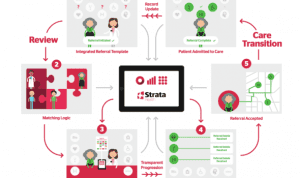
Community and home‑care providers were digitally onboarded into a unified referral network, allowing referrals to be initiated directly from the hospital. RM&R enabled simultaneous referrals to participating agencies, real‑time communication, shared visibility into referral status, and centralized tracking across the care network.
The platform functioned as the coordination hub for Southlake@home, supporting faster decision‑making and more consistent hospital‑to‑home transitions as volumes increased.
Outcomes
Since launching the digital care pathway, Southlake Health has scaled its hospital‑to‑home program significantly.
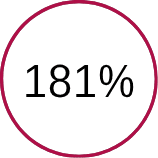
181% increase in patient volumes, growing from ~270 patients in 2020 (pre‑implementation) to 758 in 2025

8,349 referrals managed digitally (2022–2025), replacing manual, fax‑based processes

43% faster referral turnaround, reducing median processing time from 3.9 days to 2.2 days

Eight community and home‑care providers connected digitally, strengthening accountability, transparency, and coordination




“RM&R is used as the central coordination tool for Southlake@home. It allows for immediate, simultaneous referral to all Southlake@home agencies, improves visibility across teams, and reduces back-and-forth communication. This creates a more seamless, efficient process and ensures everyone is working from the same information in real time. It supports faster decision-making and improves continuity of care during transitions home.”
Renee Bakuska RN, BScN. Manager Southlake@Home
Conclusion
Southlake@home demonstrates how hospitals can scale hospital‑to‑home care by digitizing referral workflows and strengthening coordination across care settings. By leveraging Strata’s RM&R platform, Southlake Health rapidly deployed a digital pathway that supports higher volumes, reduces delays, and improves visibility, without adding infrastructure or operational complexity.
The program provides a replicable model for healthcare organizations seeking to improve transitions of care while maintaining patient‑centred coordination at scale.
About Strata Health
Strata Health, a VitalHub company, delivers innovative digital solutions that support patient flow and care coordination across the NHS and other global healthcare systems. Our platform enables real-time visibility of care resources, intelligent matching, and seamless transitions of care between services. Tailored to meet the unique needs of UK regions, Strata Health supports integrated care pathways, reduces delays, and improves outcomes for patients and providers alike.
Take the first step down a better path with Strata Health Solutions. Contact us today.